A reader of Bridging Differences asks:
"Instructivist v constructivist? Can there be some common ground between the two?"
There is common ground by implication if you listen to constructivist rhetoric as in the excerpt below from the Association for Supervision and Curriculum Development (ASCD). For example, both schools of thought believe in asking students probing questions and in pressing them to explain their thinking. It only seems there is a gulf because all too often constructivists give the impression they invented asking students probing questions and pressing them to explain their thinking. For all I know, constructivists also claim they invented the recipe for apple pie.
Among the differences I can see is the role of the teacher. In addition to being an active listener and a coordinator and a manager and a facilitator, instructivists also want teachers to give explicit instruction.
From ASCD:
[What is the teacher's role in the constructivist classroom?
Narrator: A constructivist approach requires more of students—and teachers as well.
In addition to providing information, teachers must probe students' understandings, paying close attention to what they say and think and valuing their points of view. Teachers circulate more, talk more with students, asking them probing questions, pressing them to explain their thinking, encouraging them to draw conclusions.
Jacqueline Grennon Brooks: The teacher has a very proactive role. The teacher has a very intellectually rigorous role. The teacher has the role of being an active listener and a coordinator and a manager and a facilitator all at the same time. Because, while listening to what people are telling him or her, the teacher is formulating a plan of action.]
What is still shrouded in mystery as far as I am concerned is this whole issue of constructing knowledge rather than receiving it from others, e.g. from teachers and textbooks. What are the sources of external input if textbooks and explicit teacher instruction are out? It’s easy to proclaim that students learn best when they gain knowledge through exploration and active learning. But how does that work specifically in the various disciplines? OK, I can explore circles and pi, but how will I learn world history or geography or languages with hands-on materials instead of textbooks? How will I explain my reasoning, if I am not supposed to commit knowledge to memory? And why is reading a book or listening to the teacher and trying to understand the materials not active learning? What is learning if not something committed to memory? Why do constructivists disparagingly characterize a demonstration of learning residing in memory (where else would it reside?) as "regurgitation"?
Again from ASCD:
[The Definition of Constructivism
Constructivism is an approach to teaching based on research about how people learn. Many researchers say that each individual constructs knowledge rather than receiving it from others.
Although people disagree about how to achieve constructive learning, constructive teaching is based on the belief that students learn best when they gain knowledge through exploration and active learning. Hands-on materials are used instead of textbooks, and students are encouraged to think and explain their reasoning instead of memorizing and reciting facts. Education is centered on themes and concepts and the connections between them, rather than isolated information.]
Constructivists rail against committing factual knowledge to memory but are all for making connections. It's like trying to connect the dots without the dots.
Showing posts with label Constructivism. Show all posts
Showing posts with label Constructivism. Show all posts
Sunday, March 02, 2008


Monday, January 21, 2008
Gates wrecking ball
Propelled by Gates millions, Chicago's high schools are being transformed to conform to progressive/constructivist visions to save the disadvantaged. The transformation is a fantasy that will not save the disadvantaged. It will make them even more disadvantaged. The visions being implemented on a wholesale basis rest on misdiagnoses of the reasons for academic failings. The seeds for failure are planted in elementary and middle schools. What is needed is quality education and rigor in the grades preceding high school.
With respect to science education, Catherine Johnson of KTM observed: "I do recall David Klein once telling me that the situation in science is even worse than the situation in math." I am reproducing my response here:
The situation in science is indeed dismal. Here in Chicago, constructivist ways in science called inquiry (FOSS, STC, IES, SALI, IEY) are largely the norm up to eighth grade, especially in failing schools (most of them). The educationist motto seems to be: If poison makes them sick, give them more poison.
You can also tell something is fishy when acronyms proliferate (alphabet soup proliferation). For example, science for 8th grade is IEY which stands for Issues, Evidence and You.
The HUGE SCANDAL in my view is that most high schools here in Chicago are being converted to constructivism (inquiry). It's a Gates idea called high school transformation. Gates dangled millions in front of the mayor and board who immediately jumped. A Gates agent was made executive director of the transformation project. That means academic textbooks go in the garbage and community projects are the new forms of learning science.
This scandal is taking place unnoticed by the local media. It raises the question whether one wealthy individual should be allowed to implement his fantasy and wreck high schools which after all are public entities. Resistance from school administrators and teachers is ignored. The transformation is imposed from above by fiat.
Schools can select from two or three virtually identical inquiry programs the way the politburo used to put up two or three apparatchiks as the only choice in an election. Even that pseudo choice is constrained in some cases. Now I hear that the board abolished earth science as a graduation requirement to accomodate the Gates fantasy. Two of the three pseudo choices don't even have earth science.
I wrote a comment I posted on the district299 blog that deals with Chicago ed issues. I reproduce it here (note what is in store for high school math):
The whole high-school transformation project looks like a stealth operation, really a coup. There is no HST website, no transparency. The HST office is unable to provide information on newly targeted high schools. The only (spotty) information is through the grapevine.
The project pretends to be democratic, but it is a sham. Schools can volunteer the way the Chinese Communists can produce "volunteers" en masse. It's also unclear what the total number of targeted HS is. A CPS document I have talks about three waves of 14, 15 and 20 schools respectively, making it a total of 49 HS. Other sources put the number higher.
Then there is the question of effectiveness. Will the new nostrums really improve academic achievement? Alexander Russo asks the perfect question: "Are things any better at the schools that started doing HST a couple of years ago?" There should already be evidence showing whether the nostrums are working. Why is that evidence or lack of evidence not discussed? It would have been prudent to run pilots before embarking on wholesale, highly questionable transformation. I can only conclude it wasn't done because it would interfere with putting this fantasy in place. Hence the pseudo-democratic stealth operation.
Targeted schools get to choose one of two or three IDSs. IDS stands for Instructional Development System and incorporates six "change levers" (note the nebulous, new-age lingo). IDSs are the heart of the nostrum and are described as the pillars of the core instructional strategy. The actual IDSs are simply progressive/constructivist, mainly NSF-supported, tracts that are trying to do to HS what's been done to elementary and middle schools with disastrous results.
The IDS choices in math are Agile Mind and Cognitive Tutor. In science there are three pseudo-choices: Inquiry to Build Content, Content to Build Inquiry and Meaningful Science through Inquiry. These are vastly stripped of content but they say they make up for this lack of content by motivating students to go deep. The motivation is said to come from touching the lives of students.
Content can take a back seat since according to the "Foundational principles for IDS instruction" the goal is inquiry and engaged learning. Here the "principle" says: "Focus is on problem solving, reasoning, critical thinking. Students seek their own knowledge, formulate arguments. Activities should maximize connection to student lives." How much critical thinking can go on without much to think about is anybody's guess.
My view is that the HST project is another instance of barking up the wrong tree. A lot of the disadvantaged coming from the elementary and middle grades are disastrously ill-prepared for HS. As a middle grades teacher I see these horrific deficiencies all the time. Those concerned with the success of the disadvantaged need to focus on what comes before high school.
Thursday, January 17, 2008
Constructing misconceptions
A core tenet of the progressive/constructivist education creed is that students must construct their own knowledge. For this reason, according to the creed, teachers should not impart knowledge or provide explicit instruction. A teacher should merely be a guide on the side instead of a sage on the stage, as the rhyming slogans of the creed have it.
I was recently watching a video called A Private Universe produced by the Harvard-Smithsonian Center for Astrophysics two decades ago that casts doubt on the wisdom of the knowledge construction dogma. The video shows students who were asked to explain what causes the seasons and the phases of the moon. From Harvard graduates to bright freshman, the explanations were all wrong. In other words, all these students were laboring under misconceptions.
The lesson here is that constructing one's own knowledge in areas like science has a great potential of leading to false beliefs. Many of these students probably had received explicit instruction from knowledgeable teachers and yet tenaciously persisted in constructing their own false knowledge. The way to correct these misconceptions cannot possibly be more construction of one's own knowledge as mandated by the creed, but teacher-centered ongoing diagnoses of the many misconceptions and heavy doses of explicit instruction with constant student feedback.
Here is how the producers describe the video:
With its famous opening scene at a Harvard graduation, this classic of education research brings into sharp focus the dilemma facing all educators: Why don’t even the brightest students truly grasp basic science concepts? This award-winning program traces the problem through interviews with Harvard graduates and their professors, as well as with a bright ninth-grader who has some confused ideas about the orbits of the planets. Equally useful for education methods classes, teacher workshops, and presentations to the public, A Private Universe is an essential resource for science and methodology teachers.
Saturday, May 19, 2007
Soliciting ed guru advice
I need advice from constructivist ed gurus.
Over and over, I run into this bit of "insight" from constructivists: "Knowledge is constructed by the learner from experience." First, I was beaten over the head with this "insight" in ed school. Now I see it at constructivist sites like this one.
What does it mean? How does it work in practice?
I tried to put it to the test. I decided I want to know something about Tang and Song China. According to constructivists, I need to construct that knowledge from experience. What should I do? I don't have any experience with Tang and Song China. I live now, not in the era of Tang and Song China. Then I hit on a brilliant idea: time travel. I tried cranking up that rusty, old time machine. It didn't work. Now I am trying to construct without experience but with the help of a hat. I am trying to pull the knowledge out of a hat. Ain't working either. I guess I'll just settle for a book and ignore the constructivist piffle.
My conclusion is that either constructivists keep repeating the same nonsense (probably due to a lack of critical thinking ability), or there is something I am not getting. I suspect the former.
Ed guru advice welcome.
On the same site I find this gem:
Radical constructivists do not advocate goals, sequential instruction, aids to learning, or restrictions on content for learners because each learner is unique and educators do not know what the learners need or want to learn.I've got news for these "educators": In my experience, a lot of "learners" don't know what they need either. As for wanting to learn: Forget it!
Saturday, April 28, 2007
Making connections
In IF You Liked Whole-Word Reading, Open Classrooms & Fuzzy Math
You Will Love Inquiry-Based Science Charles Ormsby makes connections between modern fads dreamed up by ed gurus. What loony idea will come next? Suggestions welcome.
Teaching different achievement levels simultaneously is particularly obnoxious. It violates a basic law of physics that says that a body cannot be in different places at the same time. Consequently, teacher input is fragmented and rendered ineffective. But what are laws of physics to ed gurus who don't believe in a stable body of knowledge and instead conceive of knowledge only as "information" that keeps changing so rapidly that it need not be learned?
Guru advice that there is no need to learn anything because one can always look up the "information" somewhere is also fallacious. A lot of things we might know require extensive struggle to achieve understanding. I teach middle grades math and see daily that achieving an understanding of topics like ratios, proportions, percentages, unit rates, operations with integers, geometry, even ordering fractions, doesn't come easily. It's not a matter of looking it up when needed and grasping it instantly. It requires time and effort. What is true for math is also true for science and other subjects. Imagine trying to "look up" and understand topics in organic chemistry without a laboriously acquired firm grounding in chemistry. Or making sense of all the difficult terms in biology that were never memorized and understood if guru advice is followed.
See this hilarious video and see how handy "looking it up when needed" is.
[Note: There is certainly no dearth of grossly ignorant people. However, this video appears to be rigged by means of selectiveness to promote a biased point of view. The selection of people being interviewed is hardly representative. One could easily do the opposite: Interview a sizable number of people at random and then select only the knowledgeable ones to "prove" that the public is highly sophisticated.]
Here Ormsby:
UPDATE: rightwingprof left a comment pointing out that we have a demonstration here of a student-centered classroom. Student centered indeed!
You Will Love Inquiry-Based Science Charles Ormsby makes connections between modern fads dreamed up by ed gurus. What loony idea will come next? Suggestions welcome.
Teaching different achievement levels simultaneously is particularly obnoxious. It violates a basic law of physics that says that a body cannot be in different places at the same time. Consequently, teacher input is fragmented and rendered ineffective. But what are laws of physics to ed gurus who don't believe in a stable body of knowledge and instead conceive of knowledge only as "information" that keeps changing so rapidly that it need not be learned?
Guru advice that there is no need to learn anything because one can always look up the "information" somewhere is also fallacious. A lot of things we might know require extensive struggle to achieve understanding. I teach middle grades math and see daily that achieving an understanding of topics like ratios, proportions, percentages, unit rates, operations with integers, geometry, even ordering fractions, doesn't come easily. It's not a matter of looking it up when needed and grasping it instantly. It requires time and effort. What is true for math is also true for science and other subjects. Imagine trying to "look up" and understand topics in organic chemistry without a laboriously acquired firm grounding in chemistry. Or making sense of all the difficult terms in biology that were never memorized and understood if guru advice is followed.
See this hilarious video and see how handy "looking it up when needed" is.
[Note: There is certainly no dearth of grossly ignorant people. However, this video appears to be rigged by means of selectiveness to promote a biased point of view. The selection of people being interviewed is hardly representative. One could easily do the opposite: Interview a sizable number of people at random and then select only the knowledgeable ones to "prove" that the public is highly sophisticated.]
Here Ormsby:
As if deciding that we shouldn’t teach the magic code was not enough, professional educators decided to re-engineer the learning environment in the classroom. Again, we have thousands of years of experience in the design of learning environments. Past experience underlined the need for mental focus and concentration … a condition that is seriously hampered by distractions. Even parents who are not trained as educators seem to realize that children should turn off the TV and rap music while trying to absorb a history or math lesson.
Last week I had occasion to witness a classroom in the inner city run by an admittedly incompetent substitute that was completely thrashed by pupils running wild like atoms flying around in a heated substance. It brought to mind the stark contrast between guru preachings about "inquiry," "discovery," "constructing knowledge and meaning," natural curiosity, and the reality of this classroom.But our education gurus had a deeper insight than the rest of us mere mortals could possibly appreciate. They figured that if you put classrooms together, without walls between them, the students would benefit from all the noise. It made sense to them, apparently, that understanding algebra or trigonometry would be enhanced by students reciting Shakespeare in the adjacent classroom! What were they thinking?
To make matters worse – is it even possible? – educators decided to give the teachers an extra challenge. Instead of having teachers teach a subject to a set of students who are roughly at the same achievement level in a subject, they decided to force them to teach to multiple levels simultaneously.
In a fourth-grade math class, teachers are required to teach simple addition and multiplication to some students while teaching division to others, and fractions to their most advanced students.
When it comes time for English Language Arts (read’n & write’n), they must simultaneously teach basic reading skills to some while discussing the classics with others.
Of course, they can’t actually do these things simultaneously, so they have to break up the class into more homogeneous groups and then split their time among the groups. Now students who could have had the teacher’s attention for the whole class, can only get it for a portion of the class time.
Brilliant!
Since the teacher splits the class up to make the sub-groups more similar in achievement level, one might ask, “WHY DIDN’T THEY DO THIS IN THE FIRST PLACE?” What were they thinking?
UPDATE: rightwingprof left a comment pointing out that we have a demonstration here of a student-centered classroom. Student centered indeed!
Saturday, April 07, 2007
What I learned in PD today
From a professional development day inspired by an ASCD presentation by Dr. Jan Jones called Building Millennial Minds: Preparing Today's Students for Tomorrow's World I learned that:
Change is exponential. Gates says technology capacity doubles every nine months. Photonics leads to unimaginable data transmission rates. Semantic Web will be our new global brain.
The world is changing four times faster than schools (Dr. Willard Daggett).* Actually, the doctor is a bit fuzzy with the number. The exact number is 4.2651.
[The vision I have is of a globe spinning so rapidly that it'll throw everyone into space, including educationists].
Kids are immersed in fancy new technology (digital natives).
People will not earn a living, they'll learn a living.
21th century skills redefine core skills. What are those new core skills? Deep conceptual knowledge, critical thinking, creativity and problem-solving, innovation, imagination.
[I am afraid the mindless repetition of the critical thinking mantra will dull the senses and stop all thinking in its track. What's needed is critical thinking about "critical thinking."]
What are the implications for teaching of all this? I quote: "Learning can no longer be full, frontal lecturing or recall of data/facts, content."
[This is a spectacular non sequitur. Doubling technology capacity (whatever that is), faster data transmission rates and kids running around with iPods have no bearing on what content should be learned and how it should be taught. If it isn't dizzying technological change but the call for "deep conceptual knowledge" that necessitates the abandonment of content recall, then there is trouble, too. How is one supposed to have "deep conceptual knowledge" without engagement with content, i.e. assimilating or learning the content? Recall is another way of saying that content has been learned. A conceptualization is an abstraction from facts, a way to bring order to otherwise disparate facts. Conceptual knowledge, deep or otherwise, is impossible without that basis. So once again, educationists are blowing smoke, apparently enamored of the high-falutin' sound of these phrases without applying some critical thinking.]
What takes its place:
Big ideas
21th century learnings [note the plural]
Melding disciplines
Unique connections
Meta-cognitive options
Focusing instruction on relevance (don't fixate on minutiae, high-stakes testing)
Digital age literacies, e.g. health & wellness literacy, visual/performing arts literacy, information literacy, multicultural literacy... [Another example of educationist corruption of a good word that is now rendered meaningless].
So just go ahead, do the critical thinking and creating. No need to know anything.
*The sound of "change" makes educationists delirious. It's as intoxicating as a bottle of vodka. The change that whips them into a frenzy is mostly of a superficial nature, like faster data transmission rates and higher flash card storage capacity, kids adept at playing with new electronic gadgets and so on. From this they draw illogical conclusions about what and how things should be taught.
To calm them down from this frenzy and to rehearse critical thinking skills, I recommend that educationists be required to write a rigorous, lenghty and critical essay before Ed. D.'s are handed out. This essay could be called Change and Continuity. The objective of this essay is to examine what changes are occurring, whether these changes are profound or superficial and what, if any, effect they should have on the academic curriculum.
Educationists should then compare and contrast these changes to what stays the same in the various subject areas, 21th century or not. Educationists could ask themselves a long list of questions pertaining to the various disciplines. For example, do faster data transmission rates and high-capacity flash cards alter the laws of gravity and motion, planetary orbits and atom bonding, or the electromagnetic spectrum and Fraunhofer lines? Do these technological changes impinge on photosynthesis and animal cell structure? Or refraction and the Doppler effect? Do they make 2 + 2 = 4 untrue? Is pi no longer the ratio of circumference to diameter because of dizzying 21th century changes and yet-unheard of electronic gadgets? Did Caesar suddenly not cross the Rubicon because Gates predicts a doubling of technological capacity every nine months?
Requiring educationists to pose and answer these questions could have a sobering effect. But I wouldn't count on it.
So that's what it is!
Maybe one day I'll pin down what this "constructivism" is. Is it a theory of knowing as some claim? Or is it an approach to teaching as the influential Association for Supervision and Curriculum Development claims:
The Definition of ConstructivismSo, many researchers say that each individual constructs knowledge rather than receiving it from others. Ain't that grand. How did these researchers figure this out? Did they research how each individual constructs the periodic table, how atoms bond, how the sun produces energy? How individuals construct knowledge about the Renaissance period? Ah, I forgot. Through hands-on materials instead of textbooks.
Constructivism is an approach to teaching based on research about how people learn. Many researchers say that each individual constructs knowledge rather than receiving it from others.
Although people disagree about how to achieve constructive learning, constructive teaching is based on the belief that students learn best when they gain knowledge through exploration and active learning. Hands-on materials are used instead of textbooks, and students are encouraged to think and explain their reasoning instead of memorizing and reciting facts. Education is centered on themes and concepts and the connections between them, rather than isolated information.
Source: From The Language of Learning: A Guide to Education Terms, by J. L. McBrien and R. S. Brandt, 1997, Alexandria, VA: Association for Supervision and Curriculum Development.
Sunday, March 04, 2007
Educationist misconceptions
Good discussion at KTM II on constructivism. ("Constructivism attacks the immune system that saves us from silliness")
I even managed to deliver myself of an opinion that then accidentally turned into a brief statement of my teaching philosophy:
I even managed to deliver myself of an opinion that then accidentally turned into a brief statement of my teaching philosophy:
I cannot understand for the life of me how construction and discovery can be compatible. If knowledge is just lying around the kitchen table or on the floor to be discovered, then why does it need to be constructed? If it is to be constructed, why does it need to be discovered?In the Comments section of the post, Barry Garelick cites a quote that addresses one of the major misconceptions under which educationists are laboring, namely that the constructing pupil needs no external input:
I can understand construction in the banal sense that we must somehow integrate external input (from observations, books, sage on the stage, etc.) into our knowledge apparatus, but the external input must still be there. This type of integration is necessarily always active, contrary to educationist palaver. So-called "constructivists" militate against this external input and disparage textbooks, explicit and expository instruction, etc. [All based on a misconception of constructivism. See below.]
My own favored teaching/learning model is one I dubbed the Optimal Electrode Gap model [spark gap might be better], or OEG model (somehow I feel I must turn this into an acronym. Acronyms lend legitimacy even to screwball ideas. Not that I consider the OEG model to be a screwball idea).
The analogy is taken from physics. When relatively high voltage is applied to electrodes, three things can occur depending on the electrode gap:
a) no sparks fly if the electrodes are too far apart
b) a short-circuit is created if the electrodes touch each other
and c) sparks begin flying if the gap is just right.
This technical bit lends itself beautifully as an analogy and even metaphor for education where it has major implications for teaching and learning. The flying sparks are a metaphor for true learning and understanding. The electrode gap stands for the kind of pupil/teacher interaction. Finding the right gap is at the heart of a teacher's teaching ability and skill.
If a teacher talks above the head of the pupil without connecting with the pupil's prior knowledge, then the gap is set too wide and no sparks fly. If the teacher tells the student (who may not be paying attention as is most often the case) everything without allowing for creative tension and some student struggle, then we have a short-circuit (the electrodes touch each other) and the voltage is for nought.
On the other hand, finding the right gap prevents pupil frustration on the one hand and wasted energy on the other, and can lead to student excitement and enthusiasm, and a real sense of accomplishment. [I presume Vygotsky's zone of proximal development is something along those lines, but note below how educationists manage to turn a good idea into an absurdity].
This is my teaching philosophy in a nutshell. I am not sure how all of this ties in with prevailing theories, but I suspect it incorporates elements from a variety of philosophies.
I was referring to a paper by Anderson, Reder and Simon called "Radical Constructivism and Cognitive Psychology" which appeared in a collection published by Brookings Institute in 1998. In the paper, they state:Catherine Johnson of KTM I and KTM II fame contributes a terrific quote that further elaborates on this enormously damaging and widespread educationist misconception:
“A consensus exists within cognitive psychology that people do not record experience passively but interpret new information with the help of prior knowledge and experience. The term “constructivism” is used in this sense in psychology, and we have been appropriately referred to as constructivists (in this sense) by mathematics educators. However, (AND THIS IS A BIG ‘HOWEVER’ FOLKS) denying that information is recorded passively does not imply that students must discover their knowledge by themselves without explicit instruction, as claimed by radical constructivists. In modern cognitive theories, all acquisition of knowledge, whether by instruction or discover, requires active interpretation by the learner. The processing of instruction can be elaborate, its extent growing with the amount of relevant knowledge the learner brings to the task.”
A common misconception regarding 'constructivist' theories of knowing (that existing knowledge is used to build new knowledge) is that teachers should never tell students anything directly but, instead, should always allow them to construct knowledge for themselves. This perspective confuses a theory of pedagogy (teaching) with a theory of knowing. Constructivists assume that all knowledge is constructed from previous knowledge, irrespective of how one is taught (e.g., Cobb, 1940)--even listening to a lecture involves active attempts to construct new knowledge.Barry Garelick points out that my spark gap analogy fits in nicely with Vygotsky's ZPD:
Yes, the spark gap analogy is quite good. It fits in with the Vygotsky theory of Zone of Proximal Development or ZPD. You want to teach children in that zone (i.e., the spark gap is not too wide) and provide the scaffolding or guidance to help bridge that gap.BeckyC cautions that constructivists go off the deep end when it comes to defining the pivotal term "scaffolding". Scaffolds are usually high up next to a building and I am speculating that educationists begin to suffer from a case of vertigo when they are on a scaffold and fall off. How else to explain this educationist fall into the abyss of absurdity?
It's in trying to define what constitutes scaffolding that the constructivist mischief begins again in earnest.Let's hope that through repeated exposure one or the other educationist will come to recognize the terrible misconception under which they have been laboring.
Constructivists deny the possibility of scaffolding by directly instructing or directly telling the child how to bridge the gap between what he knows and what we know he could know next. They allow indirect methods only, and they are even uncomfortable with presuming to know what the child should know next. They wait patiently, and they wait and wait. After all, it's not their child, and the child goes away at the end of the school year.
Sunday, February 25, 2007
Buzzword education
(Cross-posted at KTM II)
Wikipedia has an interesting entry on buzzwords. Buzzwords may sound impressive but have an unclear meaning. Wikipedia says: "Buzzwords are typically intended to impress one's audience with the pretense of knowledge. For this reason, they are often universal. They typically make sentences difficult to dispute, on account of their cloudy meaning."
Buzzwords should not be confused with jargon. For the most part, jargon has a well-defined technical meaning, at least to the initiated. On the other hand, buzzwords not only obscure meaning, but "can also function to control thought by being intentionally vague." As Wikipedia puts it: "In management, stating organizational goals by using words with unclear meanings prevents anybody from questioning the directions and intentions of these decisions..."
What is true for management is true for education to a high degree. Education presents a veritable cornucopia of buzzwords with vague meanings. They form the feeble corpus of the educationist Thoughtworld that would be a corpse in a more rational world. (Thoughtworld is a term coined by E. D. Hirsch to describe the nebulous educationist thought complex).
Ed schools are a rich generator of educationist fog, blasting prodigious quantities of fog into the air the way Mount Pinatubo might spew massive amounts of ash into the air until the sun is reduced to a faint glow.
And yet, astonishingly and improbably, we are asked to believe that the massive amounts of fog mixed with toxic fumes emitted by ed schools magically stop at the schoolhouse door.
It's been claimed by some, including Washington Post education writer Jay Mathews (see The Ed School Disease, Part Two) commenting on educational historian David F. Labaree's new book, "The Trouble With Ed Schools," that ed schools may be pitiful institutions and the butt of jokes, but there is no need to worry. They are not doing any harm: "Why worry about ed schools if they don't do any harm, or any good?" Mathews avers:
When attempting to write about the harm done by ed school ideology, it is hard to know where to begin. One could start with relatively minor topics like the preachments about the unimportance of correct spelling and the alleged benefits of invented spelling. One could start with the promotion of disastrous creeds like constructivism that are reflected in curricula and teaching methods, and form the core of ed school ideology.
A perusal of mission and vision statements of schools show how deeply entrenched ed school ideology is in the thinking of educationists who run the schools. Take, for example, Chicago's so-called Renaissance schools. Classrooms need to be heterogeneous, disciplines must be integrated, collaborative groups must engage in peer teaching, math and science must be learned by inquiry and discovery without coherent textbooks and so on. Among my many favorites is the Al Raby school:
It is also wrong for Mathews to presume teacher autonomy. Teachers are not free agents. They must work under the contraints imposed from above. In many schools, this means having to work with fuzzy math textbooks like TERC, Trailblazers, Connected Math, CorePlus, all execrable fuzzy math programs. The CMP teacher manual tells teachers not to provide explicit instruction. Math teachers I've talked to either follow this dictum or are agonizing over it. Often it can mean working with no textbooks at all. Periodically, an ed school-indoctrinated leadership comes in and orders the removal of textbooks and workbooks from classrooms. These are then given away or end up in the trash.
Even if teachers manage to defy ed school indoctrination, the obstacles they face in actual practice are formidable. They face not only institutional constraints (e.g. constructivist materials and approaches mandated from above), but they are also facing a student body that has been conditioned to expect to be entertained and to be resistant to expository instruction.
One of the pernicious effects of ed school ideology is how it produces an indoctrinated cadre for top leadership positions which then has the power to impose constructivist texts and practices on schools, like Chicago's CMSI. This cadre could be anything from superintendents to board members to curriculum and instruction experts to principals and supervisory bodies.
The message from this cadre is that explicit instruction should be minimized or avoided altogether; that worksheets (one of the hands-on activities that make sense) should be avoided like the plague [one reason for the highly restricted photocopying allotment given to teachers here in Chicago]; that textbooks are evil incarnate and prevent teachers from being "creative". On top of everything, overworked and frazzled teachers are expected to reinvent the wheel every day. Since many elementary teachers are not well-educated to begin with (e.g. a pathetic knowledge of history, geography and science), the one source of knowledge (textbooks) that could be a corrective is foreclosed. So you have instances of textbook-free schools. Schools without basals (hated by educationists), history and science textbooks, except for science "inquiry" manuals.
Part of this hatred for textbooks is the belief -- a component of ed school ideology -- that "information" (this is how educationists view knowledge) is exploding like supernovae, and what is true today is hopelessly obsolete tomorrow. Another reason is plain educationist disdain for facts. It interferes with "critical thinking" and "creativity" and stunts the mind.
One can see the hand of ed school ideology everywhere in school. At least I see it everywhere. I see it when DEAR (Drop Everything and Read insipid, vacuous and vapid fiction) is the first thing on the agenda in the morning when students are most receptive for more substantial stuff. This reading then takes place silently for an hour without teacher feedback. I see it in block scheduling to provide ample opportunity for time-wasting activities. I see it in contrived interdisciplinary instruction and in coloring and more coloring. I see the hand of ed school ideology indirectly when new elementary teacher candidates are released from the citadels of anti-intellectualism with scant knowledge of math, science, history, geography, grammar and languages, and subsequently validated by laughable state "content" tests.
The list goes on and on. I haven't even adressed ed school staples like learning styles, multiple intelligences, developmentally appropriate injunctions that often slide into low expectations, project and activities mania, heterogeneous grouping, expanding horizons, the travesty form of Bloom's taxonomy, and the disdain for factual knowledge. Moreover, once out of ed school, teachers continue to be assaulted with ed school ideology in the form of professional development requirements.
Wikipedia has an interesting entry on buzzwords. Buzzwords may sound impressive but have an unclear meaning. Wikipedia says: "Buzzwords are typically intended to impress one's audience with the pretense of knowledge. For this reason, they are often universal. They typically make sentences difficult to dispute, on account of their cloudy meaning."
Buzzwords should not be confused with jargon. For the most part, jargon has a well-defined technical meaning, at least to the initiated. On the other hand, buzzwords not only obscure meaning, but "can also function to control thought by being intentionally vague." As Wikipedia puts it: "In management, stating organizational goals by using words with unclear meanings prevents anybody from questioning the directions and intentions of these decisions..."
What is true for management is true for education to a high degree. Education presents a veritable cornucopia of buzzwords with vague meanings. They form the feeble corpus of the educationist Thoughtworld that would be a corpse in a more rational world. (Thoughtworld is a term coined by E. D. Hirsch to describe the nebulous educationist thought complex).
Ed schools are a rich generator of educationist fog, blasting prodigious quantities of fog into the air the way Mount Pinatubo might spew massive amounts of ash into the air until the sun is reduced to a faint glow.
And yet, astonishingly and improbably, we are asked to believe that the massive amounts of fog mixed with toxic fumes emitted by ed schools magically stop at the schoolhouse door.
It's been claimed by some, including Washington Post education writer Jay Mathews (see The Ed School Disease, Part Two) commenting on educational historian David F. Labaree's new book, "The Trouble With Ed Schools," that ed schools may be pitiful institutions and the butt of jokes, but there is no need to worry. They are not doing any harm: "Why worry about ed schools if they don't do any harm, or any good?" Mathews avers:
What I said in that column was that I had been in a lot of classrooms and had rarely seen much of this guide on the side stuff. I wasn't saying I was happy about it. We have never given the Deweyites a fair test of their theories, and I know of a few schools that have used child-centered learning to good effect. Labaree's insight is powerful and useful all the same: why worry about ed schools if they don't do any harm, or any good?The blindness revealed in this statement is astonishing. Could armies of new teachers and educational leaders who go through the rigorous ed school indoctrination process really emerge unscathed? Not very likely.
When attempting to write about the harm done by ed school ideology, it is hard to know where to begin. One could start with relatively minor topics like the preachments about the unimportance of correct spelling and the alleged benefits of invented spelling. One could start with the promotion of disastrous creeds like constructivism that are reflected in curricula and teaching methods, and form the core of ed school ideology.
A perusal of mission and vision statements of schools show how deeply entrenched ed school ideology is in the thinking of educationists who run the schools. Take, for example, Chicago's so-called Renaissance schools. Classrooms need to be heterogeneous, disciplines must be integrated, collaborative groups must engage in peer teaching, math and science must be learned by inquiry and discovery without coherent textbooks and so on. Among my many favorites is the Al Raby school:
Educational Philosphy [sic]Many of these new Chicago schools receive money from the Gates Foundation.
The Al Raby School will embody a constructivist approach to learning. Learning will be an active process; our teachers will use lecture style instruction and worksheets sparingly. All teachers will stress collaborative groups as well as individual initiative, striving to make the classroom a model democratic community where students have choices and responsibilities. Based on a large body of research, we believe that for true comprehension and retention to occur the learning must be relevant, active and reflective.
It is also wrong for Mathews to presume teacher autonomy. Teachers are not free agents. They must work under the contraints imposed from above. In many schools, this means having to work with fuzzy math textbooks like TERC, Trailblazers, Connected Math, CorePlus, all execrable fuzzy math programs. The CMP teacher manual tells teachers not to provide explicit instruction. Math teachers I've talked to either follow this dictum or are agonizing over it. Often it can mean working with no textbooks at all. Periodically, an ed school-indoctrinated leadership comes in and orders the removal of textbooks and workbooks from classrooms. These are then given away or end up in the trash.
Even if teachers manage to defy ed school indoctrination, the obstacles they face in actual practice are formidable. They face not only institutional constraints (e.g. constructivist materials and approaches mandated from above), but they are also facing a student body that has been conditioned to expect to be entertained and to be resistant to expository instruction.
One of the pernicious effects of ed school ideology is how it produces an indoctrinated cadre for top leadership positions which then has the power to impose constructivist texts and practices on schools, like Chicago's CMSI. This cadre could be anything from superintendents to board members to curriculum and instruction experts to principals and supervisory bodies.
The message from this cadre is that explicit instruction should be minimized or avoided altogether; that worksheets (one of the hands-on activities that make sense) should be avoided like the plague [one reason for the highly restricted photocopying allotment given to teachers here in Chicago]; that textbooks are evil incarnate and prevent teachers from being "creative". On top of everything, overworked and frazzled teachers are expected to reinvent the wheel every day. Since many elementary teachers are not well-educated to begin with (e.g. a pathetic knowledge of history, geography and science), the one source of knowledge (textbooks) that could be a corrective is foreclosed. So you have instances of textbook-free schools. Schools without basals (hated by educationists), history and science textbooks, except for science "inquiry" manuals.
Part of this hatred for textbooks is the belief -- a component of ed school ideology -- that "information" (this is how educationists view knowledge) is exploding like supernovae, and what is true today is hopelessly obsolete tomorrow. Another reason is plain educationist disdain for facts. It interferes with "critical thinking" and "creativity" and stunts the mind.
One can see the hand of ed school ideology everywhere in school. At least I see it everywhere. I see it when DEAR (Drop Everything and Read insipid, vacuous and vapid fiction) is the first thing on the agenda in the morning when students are most receptive for more substantial stuff. This reading then takes place silently for an hour without teacher feedback. I see it in block scheduling to provide ample opportunity for time-wasting activities. I see it in contrived interdisciplinary instruction and in coloring and more coloring. I see the hand of ed school ideology indirectly when new elementary teacher candidates are released from the citadels of anti-intellectualism with scant knowledge of math, science, history, geography, grammar and languages, and subsequently validated by laughable state "content" tests.
The list goes on and on. I haven't even adressed ed school staples like learning styles, multiple intelligences, developmentally appropriate injunctions that often slide into low expectations, project and activities mania, heterogeneous grouping, expanding horizons, the travesty form of Bloom's taxonomy, and the disdain for factual knowledge. Moreover, once out of ed school, teachers continue to be assaulted with ed school ideology in the form of professional development requirements.
Sunday, December 18, 2005
Eduvacuity
The Fordham Institute has published a major review of state science standards. According to the study, a handful of states has managed to produce respectable standards. However, the vast majority of state standards is afflicted with numerous problems, most notably with the "constructivist" anti-knowledge plague:
Educational ConstructivismThe California science framework has received top marks and can be read here.
Constructivism is not new. It was evident in the first draft
(1992) of the National Science Education Standards, where
it took the form of a claimed postmodern philosophy of science. That, in turn, incorporates one kind of constructivism (“social” constructivism) about knowledge, including scientific knowledge.The adopted philosophy was an application to learning standards of the increasingly popular educational constructivism,whose main tenet is that learning happens only by an individual’s action, his or her making and doing things in the world, not as a result of any conveyance of knowledge (as in teaching).10 A revision of that early draft eliminated the praise of postmodernism but left in place the notion that a learner can do no more than to construct knowledge, which is therefore personal, from things and events in his or her sensed environment. It is supposed to follow from this that scientific knowledge cannot be transferred from one person—a teacher (or from a book)—to another. The learning expectations of standards should therefore focus much more on process, the “doing”of science by the student, and much less on its reputed facts.11
Sunday, November 13, 2005
Alternative to fuzzy math denied
An illuminating story appeared in the NYT on how the fuzzy math plague plays out in a Rochester, NY, suburb:
After citing example after example of math cripples, the article has this gem that shows the arrogance of educationists:LAST spring, when he was only a sophomore, Jim Munch received a plaque honoring him as top scorer on the high school math team here. He went on to earn the highest mark possible, a 5, on an Advanced Placement exam in calculus. His ambition is to become a theoretical mathematician.
So Jim might have seemed the veritable symbol for the new math curriculum installed over the last seven years in this ambitious, educated suburb of Rochester. Since seventh grade, he had been taking the "constructivist" or "inquiry" program, so named because it emphasizes pupils' constructing their own knowledge through a process of reasoning.
Jim, however, placed the credit elsewhere. His parents, an engineer and an educator, covertly tutored him in traditional math. Several teachers, in the privacy of their own classrooms, contravened the official curriculum to teach the problem-solving formulas that constructivist math denigrates as mindless memorization.
"My whole experience in math the last few years has been a struggle against the program," Jim said recently. "Whatever I've achieved, I've achieved in spite of it. Kids do not do better learning math themselves. There's a reason we go to school, which is that there's someone smarter than us with something to teach us."
By last spring, these parents had discovered one another and their common exasperation with constructivist math. Jim Munch's father, Bill, a software developer at Kodak, drew up a petition asking the Penfield schools to offer pupils the option of taking traditional math. Nearly 700 residents signed it. Last June, the Board of Education turned down the request.The superintendent haughtily dismisses parent concerns. Many of the parents have extensive math backgrounds:
Susan Gray, the superintendent, attributed the criticism of the math program to "helicopter parents" who are accustomed to being deeply involved in all aspects of their children's lives. "Because the pedagogy has changed, the parents who knew the old ways didn't know how to help their children," she said. "They didn't have the knowledge and skills to support their children at home. There's a security in memorization of math facts, and that security is gone now."
YET many of the dissident parents have extensive math backgrounds and thus the ability to criticize the curriculum. It is also true that most of them tolerated the constructivist program for its first several years, until bitter experience drove them into rebellion.
Saturday, October 08, 2005
Arrested development
Constructivism reigns supreme in ed schools. It is the unquestioned doctrine that guides all aspects of teacher preparation. It should therefore be of some interest to find out what it is all about, if there is an empirical core that can be discerned from the thick fog that envelops hapless teacher candidates. The prospects are not good. Von Glaserfeld calls constructivism "a vast and woolly area in contemporary psychology, epistemology, and education."
Trying to pin down constructivism -- to see if it can be defined in a meaningful way and whether there is any sense that can be separated from nonsense -- is like searching for the unicorn.
At this point of my search, the best I can do is conclude that constructivists display a case of arrested development. Constructivists are stuck in the Piagetian sensorimotor or, at best, pre-operational stage. This infantilism that manifests itself in constructivists goes a long way in explaining educationist hostility to knowledge and educationist anti-intellectualism. But this infantilism is golden compared to the denial of objective reality by radical constructivist gurus like von Glaserfeld.
Let me elaborate a bit.
Constructivists cite Piaget and Vygotsky as their progenitors. Piaget did groundbreaking work on how toddlers develop intellectually and came up with different stages (really a continuum divided into stages to get a better handle on this development). For example, a toddler might recognize at some point that an object that is moved behind another object and disappears from sight does not cease to exist (permanence). Or a toddler might discover on his own that an object falls when released or that bumping into a wall is not a good idea or that a flame is hot.
The constructivists' fallacy is to carry this notion of discovery and individual experience to absurd lengths and apply it to later years -- to adolescence and even adulthood. Learning then becomes solely a matter of discovery and individual experience from which one constructs one's own knowledge and meaning. But you cannot "construct" broader knowledge ex nihilo and keep reinventing the wheel endlessly. You need external input. You need to benefit from the knowledge accumulated over thousands of years. This is where constructivism breaks down. Constructivism presents itself as a theory of learning based solely on experience. But personal experience is limited. Broader learning also needs to tap into an existing body of knowledge that constructivists disparage.
This otherwise imcomprehensible educationist hostility to knowledge and especially imparting knowledge becomes clearer when one considers the views of leading radical constructivist gurus like von Glaserfeld who seem to come straight out of the loony bin:
Woolfolk goes on to helpfully explain how knowledge is constructed citing Moshman (1982). Knowledge construction is directed by internal processes like Piaget's organization, assimilation and accommodation. This means that new knowledge is "abstracted from old knowledge." It turns out that "[k]nowledge is not a mirror of reality, but rather an abstraction that grows and develops with cognitivie activity. Knowledge is not true or false; it just grows more internally consistent and organized with development."
Talk about being self-referential. Where is the external input?
I don't know what to make of this. I can understand that we might have to readjust our thinking when we learn new things that might conflict with or supplement our previous knowledge. But apparently there is no input of new knowledge from an external source. Saying that knowledge is constructed by transforming, organizing, and reorganizing previous knowledge is purely self-referential. Previous knowledge is simply remixed and stirred the way you might mix the ingredients of a cake. Nothing new is added. How relevant is all this to teaching reading and writing skills, math, science, history, geography, literature or languages?
Neither relevant nor helpful. It's all nonsense -- nonsense on stilts that has managed to become the dominant creed of the ed establishment. Constructivism is to education what creationism is to science. Both lack an empirical basis and rely on some unfathomable, ineffable, magical, supernatural thing said to "construct" something out of nothing.
How refreshing, then, to have someone like Prof. Plum rip the mask off this pretentious drivel:
UPDATE #3: Here are more sources on constructivism:
http://mathforum.org/mathed/constructivism.html
Trying to pin down constructivism -- to see if it can be defined in a meaningful way and whether there is any sense that can be separated from nonsense -- is like searching for the unicorn.
At this point of my search, the best I can do is conclude that constructivists display a case of arrested development. Constructivists are stuck in the Piagetian sensorimotor or, at best, pre-operational stage. This infantilism that manifests itself in constructivists goes a long way in explaining educationist hostility to knowledge and educationist anti-intellectualism. But this infantilism is golden compared to the denial of objective reality by radical constructivist gurus like von Glaserfeld.
Let me elaborate a bit.
Constructivists cite Piaget and Vygotsky as their progenitors. Piaget did groundbreaking work on how toddlers develop intellectually and came up with different stages (really a continuum divided into stages to get a better handle on this development). For example, a toddler might recognize at some point that an object that is moved behind another object and disappears from sight does not cease to exist (permanence). Or a toddler might discover on his own that an object falls when released or that bumping into a wall is not a good idea or that a flame is hot.
The constructivists' fallacy is to carry this notion of discovery and individual experience to absurd lengths and apply it to later years -- to adolescence and even adulthood. Learning then becomes solely a matter of discovery and individual experience from which one constructs one's own knowledge and meaning. But you cannot "construct" broader knowledge ex nihilo and keep reinventing the wheel endlessly. You need external input. You need to benefit from the knowledge accumulated over thousands of years. This is where constructivism breaks down. Constructivism presents itself as a theory of learning based solely on experience. But personal experience is limited. Broader learning also needs to tap into an existing body of knowledge that constructivists disparage.
This otherwise imcomprehensible educationist hostility to knowledge and especially imparting knowledge becomes clearer when one considers the views of leading radical constructivist gurus like von Glaserfeld who seem to come straight out of the loony bin:
Von Glaserfeld is one of the leading apostles of radical constructivism. Radical constructivism rejects the traditional philosophical position of realism and adopts a relativist position. The traditional view of realism sees knowledge as a representation of an absolute reality - a world "out there" prior to having been experienced. The radical constructivists sees knowledge as "something that is personally constructed by individuals, in an active way, as they try to give meaning to socially accepted and shared notions." As von Glaserfeld himself says "knowledge is the result of an individual subject's constructive activity, not a commodity that somehow resides outside the knower and can be conveyed or distilled by diligent perception or linguistic communication"
This explains why educationists don't believe in an external body of academic knowledge that should be communicated to students. It explains why teachers are not allowed to teach, i.e. give explicit instruction.
On the other hand, how constructivists can claim Vygotsky as one of their own still remains a mystery to me. His notions of the zone of proximal development and scaffolding are sensible and don't rule out explicit instruction (despised by constructivists). His emphasis on socio-cultural factors doesn't fit in with "constructing one's own knowledge" either.
I wish someone could explain all these mysteries to me.
UPDATE #1: In the meantime, reader Rob has helpfully directed me to a scholarly article called Does No One Read Vygotsky’s Words? Commentary on Glassman that exposes attempts to Deweyize Vygotsky through omissions, distortions and inventions.
From the abstract:
In the May 2001 issue of Educational Researcher, Michael Glassman proposed several commonalities in the thinking of John Dewey and Lev Vygotsky. However, in addition to general problems in the article (misstatements about scholars’ writings and a reliance on unsupported inferences), the discussion misconstrues major concepts and topics addressed by Vygotsky’s theory of cognitive development—psychological tools, the role of the cross-cultural study, the zone of proximal development, and the nature of conceptual thinking. In addition, Glassman attempted to force Vygotsky’s goals into a Deweyan framework. The result is a misportrayal of Vygotsky’s work.UPDATE #2: I dug out my ed psych text (Anita Woolfolk) we used in grad school to see what it says about Piaget and constructivism. From it I learn that knowledge is "constructed by transforming, organizing, and reorganizing previous knowledge. Knowledge is not a mirror of the external world, even though experience influences thinking and thinking influences knowledge. Exploration and discovery are more important than teaching." The quote is Woolfolk speaking and giving a summary of Piaget's purported views under the heading "Assumptions about Learning and Knowledge."
Woolfolk goes on to helpfully explain how knowledge is constructed citing Moshman (1982). Knowledge construction is directed by internal processes like Piaget's organization, assimilation and accommodation. This means that new knowledge is "abstracted from old knowledge." It turns out that "[k]nowledge is not a mirror of reality, but rather an abstraction that grows and develops with cognitivie activity. Knowledge is not true or false; it just grows more internally consistent and organized with development."
Talk about being self-referential. Where is the external input?
I don't know what to make of this. I can understand that we might have to readjust our thinking when we learn new things that might conflict with or supplement our previous knowledge. But apparently there is no input of new knowledge from an external source. Saying that knowledge is constructed by transforming, organizing, and reorganizing previous knowledge is purely self-referential. Previous knowledge is simply remixed and stirred the way you might mix the ingredients of a cake. Nothing new is added. How relevant is all this to teaching reading and writing skills, math, science, history, geography, literature or languages?
Neither relevant nor helpful. It's all nonsense -- nonsense on stilts that has managed to become the dominant creed of the ed establishment. Constructivism is to education what creationism is to science. Both lack an empirical basis and rely on some unfathomable, ineffable, magical, supernatural thing said to "construct" something out of nothing.
How refreshing, then, to have someone like Prof. Plum rip the mask off this pretentious drivel:
What is Constructivism?What does progressive/constructivist education actually look like in practice. Here we have a smartly written account from someone who is experiencing it first hand:
Constructivism is big word that makes education perfessers think they are intelligent.
Constructivism is an invention that makes education perfessers think they know something that everyone else doesn't.
Constructivism is a set of statements about learning that are quite simpleminded and generally false.
"Knowledge can't be transmitted from one person to another. 'Learners' have to construct knowledge." [This very statement shows that constructivists don't believe what they say. Isn't the statement an effort to transmit knowledge?]
"Therefore, teachers should not teach directly by telling or showing (e.g., how to solve math problems). Instead, they should guide students as STUDENTS figure out concepts (what granite is) and strategies (how to sound out words, how to solve math problems)." [Constructing knowledge means NOTHING more than comparing and contrasting, identifying sameness and difference, making inductions and deductions. This is all OLD news. There is NO reason why teachers can't teach in a direct and focused fashion. In fact, students "construct knowledge" (figure things out) better--faster and with fewer errors--when they ARE taught directly, rather than expected to "discover" knowledge--which makes no sense, anyway. If knowledge is constructed, what IS there to discover?]
"How each person constructs knowledge is unique. Therefore, teachers should not arrange instruction in sequences. Instead, students should select learning tasks. Don't worry. They will select what they are ready for." [Unique in the DETAILS but not in the general logical operations by which human beings learn. If each person is unique, I guess physicians should not take their blood pressure.]
"Drill (distributed practice) is bad. It is boring. It is not needed." [Baloney!]
"Tasks should be 'authentic.' Holistic. Teach the fundamentals of chemistry in the CONTEXT of chemistry experiments. Teach phonics skills in the context of reading." [This is the prescription for keeping kids ignorant and unskilled and for leaving them demoralized.]
"Since each student's learning is unique and INTERNAL, you cannot use quantitative and standardized methods of assessment. It should be qualitative--how students feel and think about what they are learning." [This makes no sense. Body temperature is also "internal," but you can measure it quantitatively and with a standard instrument. Likewise, you can easily count how many math problems kids do correctly. This is a cop-out to protect constructivists from data that would ruin them.]
And from this set of sophomoric beliefs, you get whole language, fuzziest math, inquiry science, literature without literacy, and history without moral and political lessons.
...
Constructivist "theory" is a mishmash of overlapping platitudes and absurdities--"empty words and poetic metaphors" (Aristotle, Metaphysics). Taken separately, constructivist "propositions" are merely simpleminded. Taken together, they are indistinguishable from the verbal behavior of a person suffering from chronic schizophrenia.
"Reality is a construction."
"Knowledge is a construction."
"Experience is a construction."
"Experience is constructed with constructs."
"Constructs are constructed out of experience."
"Reality is knowledge."
"Knowledge is reality."
"Experience is reality."
"There is no knowable reality external to the knowing subject (the constructor)."
"Individuals and groups construct meaning as they interact with environments."
"Therefore, no statement can be more than relatively true."
"A current body of knowledge ('reality') is a context that shapes the construction of knowledge."
"Therefore, environment, knowledge, experience, meaning and reality are the same thing."
In my lesson during the first block, we read a lot of the primary source documents out loud together, and then I led a discussion about them and we took notes together. This was roundly condemned as the wrong approach, and so the next period I had to let them read and interpret in groups. As usual, they wasted a lot of time and I don't really think they understood it. Not that I'm sure they had totally understood it in the first block, since they didn't have the proper historical background and I can't give them quizzes, but at least I got some reasonable answers out of the class discussion. In the second block, everyone got something different, depending on their group. It was so frustrating. I don't want to learn to teach like this because I don't think it's right. But I can't contradict the teacher. But I need the practice. It's an education grad school moral dilemma. The best kind.This is just the last paragraph of a fairly long post. Read the whole thing.
UPDATE #3: Here are more sources on constructivism:
http://mathforum.org/mathed/constructivism.html
What is Constructivism?These prescriptions would explain the surfeit of math cripples. I know from my own experience teaching math that students thrive when having things explained to them combined with guided practice and independent homework in the form of distributed practice and overlearning.
"Students need to construct their own understanding of each mathematical concept, so that the primary role of teaching is not to lecture, explain, or otherwise attempt to 'transfer' mathematical knowledge, but to create situations for students that will foster their making the necessary mental constructions. A critical aspect of the approach is a decomposition of each mathematical concept into developmental steps following a Piagetian theory of knowledge based on observation of, and interviews with, students as they attempt to learn a concept." [Emphasis added].
- Calculus, Concepts, Computers, and Cooperative Learning (C4L)
Sunday, October 02, 2005
Non-instruction (rev.)
Of all the educational lunacies dreamed up by educationists, non-instruction must be among the looniest.
Here is an account from the frontlines of what is not happening in a high school math class. The account relates the experiences of a student in a math class in which the teacher won't teach. It was posted at Kitchen Table Math, a lively math site that has been called "the hippest online math ed community in the known universe."
Here is an account from the frontlines of what is not happening in a high school math class. The account relates the experiences of a student in a math class in which the teacher won't teach. It was posted at Kitchen Table Math, a lively math site that has been called "the hippest online math ed community in the known universe."
Hello, my name is Colin Johnston and in this post I will describe the horrors of high school algebra.As Colin says, why not just take this class at home, over the internet? Maybe constructivists are on to something and this is the wave of the future. It would help save hundreds of billions spent on "education."
On the first day of my junior year, I stepped into my math class. I will leave names out so as not to offend anyone. I had heard mixed reviews about the math teacher that I would have this year, but people generally said he was a pretty good teahcer. As the bell rang, the class sat down and waited patiently for him to enter the room. He slowly stepped into the classroom. He looked like a smart enough guy. He then passed out the textbooks and walked to the front of the classroom. He began talking about the curriculum we would cover this year, his grading scale, etc. He then said something, however, that didn't go down as easily as the other things he had mentioned. He said "You kids have been told how to do everything in your math careers. That is, up until now. This year, you are going to learn how to teach yourselves."
What? Then why don't we just take this class at home, over the internet? What is the point of having a teacher that doesn't teach? I made these same arguments to my friend after class, but he just shruged it off. "It will probably get better as the year goes on." He said. I guess I would give it a shot.
But as this year has gone on, things have gotten worse if anything. Now, the norm for the class is come in, sit down, spend an hour correcting last nights assignment (it takes so long because everyone has so many questions), get the new assignment, and puzzle over it for 10 minutes until you finally give up due to complete lack of understanding. Such is life in the new new math, Constructivism.
Wednesday, August 31, 2005
Force-fed constructivism
In the latest issue of Education Next, Sol Stern describes the tyrannical reign of the B&K regime in NYC. Teachers are being indoctrinated at the cost of hundreds of millions of dollars to become mindless robots forced to implement whacko educational theories:
As the video opens, Klein announces, “This CD will walk you through the research upon which we based our decisions regarding our program choices.” The implication is that the city’s search for the “best practices” was intellectually serious. Not so. Otherwise, this instructional guide would not be dominated by the pedagogical principles of a radical education guru from Australia named Brian Cambourne, who believes that teachers ought to encourage their students to achieve a “literacy for social equity and social justice.”Educationists pay lip service to "critical thinking" but any critical thought gets you denounced:
Professor Cambourne says he came to his theories when he discovered that many of his poorly performing students were actually quite bright. To his surprise, almost all demonstrated competence at challenging tasks in the real adult world, including poker. This led to the brainstorm that children learn better in natural settings with a minimum amount of adult help. So important does Joel Klein’s education department deem Cambourne’s theories to be that it instructs all city teachers to go through a checklist to make sure their classroom practices meet the down-under education professor’s “Conditions for Learning.” Which of four scenarios most accurately describes how your classroom is set up? teachers are asked. If the teacher can claim “a variety of center-based activities, for purposeful learning using different strategies, and for students to flow as needed,” she can pat herself on the back. But if her classroom is set up “for lecture with rows facing forward,” she must immediately change her practice.
You might ask whether there’s any evidence for such pedagogy. It’s “weak to nonexistent,” according to Reid Lyon, former head of all reading research at the National Institutes of Health. “The philosophical and romantic notion that children learn to read naturally and through incidental exposure to print and literature has no scientific merit whatsoever.”
That hasn’t deterred Chancellor Klein in the least. Constructivist pedagogical guidelines are forced on classroom teachers in weekly “professional development” sessions that are closer to a military boot camp than any serious inquiry into the best classroom practices. No dissent is allowed. Teachers are given lists of “nonnegotiables,” a strange and embarrassing concept for any education enterprise. Thus students must not be sitting in rows. Teachers are forbidden to stand at the head of the class and do “chalk and talk” at the blackboard. There must be a “workshop” (students working in groups) in every single reading period. Teachers are also provided with classroom maps indicating the exact location of the teacher’s desk, the students’ writing stations, and exactly how much of the wall space should be set aside for posting student work. Also nonnegotiable is that every elementary school classroom must have a rug.
Is it surprising then that Chancellor Klein is facing a revolt from teachers like 13-year veteran Jackie Bennett, from a Staten Island high school? Ms. Bennett’s problem is that she believes it’s not a sin to bring her knowledge of great literature to her students, even if she occasionally lectures. After all, Bennett has a master’s in English literature from Columbia University, exactly the kind of academic attainment we supposedly want more of from our teachers.
“DOE administrators talk about balance,” Ms. Bennett recently wrote in an unpublished letter to the New York Times.
"What they really want is all-group, all the time. What’s more, the message is clear: when we visit your classes and the kids are not in groups, you have one strike against you.
My recent experience at staff development is illustrative of just how clear that message is intended to be. After spending the morning working with my colleagues on a small group activity that entailed busywork that did nothing to further our development as teachers, we returned to a whole-class discussion to briefly assess what we had learned. I raised my hand and asked if there was any research tying group work to better test scores. The answer was no.
My behavior was reported to the Local Instructional Superintendent, and two days later, my assistant principal asked me to forgo attendance at the remaining meetings. I had, it seems, been kicked out of staff development. Had I made a ruckus? No. But I had asked uncomfortable questions. I had thought critically. Though the City’s Department of Education gives lip service to teaching kids to think critically, it is clear they want those critical thinking skills taught by drones."
Monday, May 16, 2005
Trivial hands-on activities
Educationists waste endless time on trivial hands-on activities and projects and then whine that requiring basic skills in reading and math is an onerous requirement that takes too much of their time. Endless, trivial, often pointless and time-wasting hands-on activities and projects are an integral part of the anti-knowledge progressive/constructivist ed ideology. It has its roots in the progressive belief that learning must be "experiential" and that one only learns by doing. That creates a bias against book learning and explicit instruction.
Here is a terrific article from American Educator that might explain why schools have such dismal results.
There is much more of this important article.
Here is a terrific article from American Educator that might explain why schools have such dismal results.
Lost In Action
Are time-consuming, trivializing activities displacing the cultivation of active minds ?
By Gilbert T. Sewall
A third-grade social studies student in California builds an Endangered Species "portfolio." For the entire year. This portfolio is given over to the demise of the toucan and the Galapagos tortoise. The portfolio is brightly colored, laminated and spiral bound, containing lots of glossy photographs clipped from magazines. Each page is thick with adhesive stick-ons and glitter. The portfolio contains many, many misspelled words and exhibits almost no understanding of the South American continent's natural history.
As traditional learning gives way in a growing number of classrooms, students encounter more and more projects and activities like the one above:
A seventh-grade suburban Maryland student builds a shoebox-sized replica of the items in his school locker for Spanish class. The academic content: He then labels the items in Spanish. Total time for the project: approximately 20 hours. Ninth-grade French class students in New York City scout cookbooks for crepe suzette and omelet recipes. They create photo montages of the Eiffel Tower and Notre Dame, making posters for display on classroom walls.
Selected members of a 10th-grade world history class receive cookies. The rest of the class goes empty-handed. This creates a room of haves and have nots. Students discuss how it feels to be left out, and how it feels to be the privileged few given the cookies to eat. The purpose: to prepare for the study of the French Revolution.
Leading textbooks, new tests, and academic journals reinforce these practices:
A third-grade math program devotes a week to the concept of 1,000. One lesson centers on "Thousand skits," in which students figure out things the class can do cooperatively to accomplish 1,000 repetitions and then try to act them out. "Work in groups of four to make up your skit. Decide what you will do, how many people you will need, and how many repetitions each person will do. Write down the directions for your skit." This lesson is taken from a textbook series the U.S. Department of Education recommended last year to school districts across the country.
A sixth-grade social studies textbook suggests: "Imagine you are a television reporter covering the Roman assault on Masada. Prepare a news report on this event."
An "authentic assessment" in "integrated science" designed to replace ordinary tests asks students to write a poem about mitosis. A journal of chemical education encourages high school science students to construct a new periodic table of the elements as it might appear on some unspecified alien planet.
No one contests some legitimate place for projects and activities in classrooms. But lost in the whirlwind, this doing and doing, is a sense of where the real action should be--in the minds of students. Activities enthusiasts are right not to want passive students. But they have made a dangerous error. They have substituted ersatz activity and shallow content for the hard and serious work of the mind.
Whether projects and activities are good or bad, successful or unsuccessful, they are without question popular. They elicit warm and positive feelings that are lodged in persuasive learning theories and sentiments held almost universally: that a variety of tasks, assignments, and methods makes education more pleasurable and memorable.
Activity-based learning is not confined to early childhood education or the lower grades, to a handful of "innovative" classrooms, to public education, or to mediocre schools. In elementary and high schools alike, public and private, it is taking the place of traditional lessons, essays, tests, and research papers. The trend is not a matter of a pendulum swinging a little too far in one direction. In many schools, activities more than supplement the text and lesson. Activities are the lesson.
Such teaching strategies have a long pedigree. Some call them the project method, a term often used interchangeably with "activities-based learning" and "hands-on learning." Content is tied to prior experiences or known student interests. In a 1996 report on how teachers try to stimulate interest in learning, John A. Zahorik at the University of Wisconsin-Milwaukee defined these hands-on activities very broadly, including lessons in which the "student is an active participant rather than a passive listener. The term includes the use of manipulatives such as pattern blocks in mathematics; playing games of all kinds; participating in simulations, role playing and drama; engaging in projects. "
Education publishers, eager to keep up with pedagogical trends, have responded. Flip to any lesson in any up-to-date textbook. You'll find projects and activities at the core of the editorial apparatus. The most ambitious of the nation's new secondary-level history textbooks, McGraw-Hill/Glencoe's American journey --whose authors include a former president of the American Historical Association and a Pulitzer Prize winner--features a Taffy Pull, complete with a recipe and an invitation for students to relive the social event of the 1800s and early 1900s.
Hands-on enthusiasts claim that traditional pedagogy and content are at the center of the "interest" problem. They assume project- and activity-based learning to be superior forms of instruction, kinder and more humane than the opposite, which is often lumped under the term "verbal learning. " Language and letters, the many-splendored world of mathematics, the vast terrain of history and science, at least in pure form, according to this outlook, are limiting, boring, and possibly emotionally harmful to children.
Traditional classroom activities and content lose out--crowded and trimmed in order to accommodate projects. There's only so much school day, and projects and activities consume time greedily. To make room, time allotted to reading, writing, listening, critical dialogue, and directed inquiry inevitably shrinks. Serious learning takes a back seat.
Activities expand exponentially because teachers think that's what they are supposed to be doing. Administrators, curriculum specialists, education gurus, workshop presenters, psychologists, academic journals, and textbook publishers have told teachers that activities are the only way to engage students. "Chalk and talk" and "drill and kill" are the derisive names given to traditional approaches. Teachers, understandably, shudder at the thought of being associated with such dreary pedagogy. Should they resist the traditional wisdom, they may face scorn and intimidation for being instructionally out of date or even insensitive to student needs.
Lack of variety and imagination in assignments does lead to dull classrooms. Whole-class, teacher-led instruction is not always of high quality. But it certainly can be, frequently is, and would be much more often if it weren't caricatured as inevitably boring and ineffective, thus discouraging teachers from perfecting the art, as Japanese and Chinese teachers work so hard and successfully to do.* (* See below).
Activities-based learning often suspends valid educational premises: that the ability to communicate derives from verbal training; that the ability to absorb, filter and process information requires facility with words and numbers; that general knowledge leads to project mastery; that getting there requires hard work and even then is not universally conferred.
The fear of passive learning may be spectacularly misdirected, but the chalk-and-talk caricature has done its work. Pressed to be events coordinators and social directors, teachers have been robbed of traditional pedagogy's vision of quality: the carefully prepared lesson, rich with analogy, illustration and anecdote; focused and guided; demanding and lively; peppered with good humor; with frequent interchange between student and teacher, student and student; interspersed with small-group work when appropriate; and with a clear sense of direction at the beginning and summary at the end, leaving all participants with a feeling of completion and satisfaction.
Sometimes teachers must inform directly; at other times they guide students to figure things out for themselves. Active, attentive listening--on the part of both teacher and students--is an imperative. Repetition, practice, and memorization have their part, as does learning to take organized notes. At the core, always, is serious content approached seriously. Knowledge builds on knowledge. Thirteen years of carefully sequenced content and jealously guarded classroom time allow students to build an enormous storehouse of knowledge and skills and the ability to use them. And since knowledge and success are the best breeding ground for interest to take root and expand, the more students know, the more they will want to know.
Under the leadership of their teacher, students work to unearth meaning; to evaluate, interpret, compare, extend, and apply; to analyze their errors, present their findings, defend their solutions; to attend carefully to what others say; to get their thoughts down clearly on paper; to understand. This is not boring and it is not passive. This is real action learning. This is the mind at work. Those who would banish such teaching by dismissing it as dull and ineffective are better advised to put their efforts into helping teachers sharpen these familiar and research-validated approaches.
There is much more of this important article.
Friday, April 01, 2005
Fuzzy math keeps spreading
This writer is making a nice analogy between reading and math. Just because technology is available, should we stop teaching kids how to read? Fuzzy math promoters seem to believe something similar by encouraging the use of calculators at an early age and by displaying hostility to memorization. The result is another generation of math cripples. Memory is one of those great gifts. It is therefore incomprehensible why educationists would wage war against memory.
To put this into perspective, consider the following analogy: Your first-grader comes home from school and tells you about the new Everyday Reading curriculum. Since there's such a prevalence of "books on tape," and with the latest technology known as text-to-speech, allowing computers to speak any text, the schools have implemented this great new program. It removes the emphasis on memorizing the alphabet and the tedium of learning to read. No more wasting time on the trivial, tedious basic mechanics of reading. No more hours spent on phonics or spelling. The new curriculum spends much more time teaching the children to analyze complex literature from a young age, since they're now freed up from the tedium of actually READING it!
Thursday, February 24, 2005
Pundit parents
The Education Wonks have done it again and assembled a delicate smörgåsbord from the edusphere.
What caught my attention, in particular, was a pundit parent's experience with EM: If your school has Everyday Math. Fortunately, there are parents who care enough about education to make an end-run around fuzzy math by either buying the right books, teaching their kids, hiring a tutor or tutoring program or all of the above.
The post also contains a long, long (and I mean looong) response from a true believer in fuzzy math, replete with accusations of "bald-faced lies" and the like.
I have often wondered to what extent the effects of fuzzy math are distorted by interference from parents. Imagine a district using fuzzy math and a number of students doing splendidly on tests (assuming the tests are not fuzzy tests). Then the results are trumpeted by the district and seen as vindication. But it turns out the results are due to what pundit parents and many others like her did: getting their kids the benefit of real math.
Saturday, February 19, 2005
Taxes finance fuzzy math
The role played by the tax-supported National Science Foundation (through its EHR division) in promoting fuzzy math is a scandal of monumental proportions. This NSF division was captured by fuzzy (constructivist) math fanatics some time ago and has been conducting an aggressive tax-financed campaign ever since to spread the constructivist gospel far and wide.
The results are described in this excellent article in Education Next by Barry Garelick.
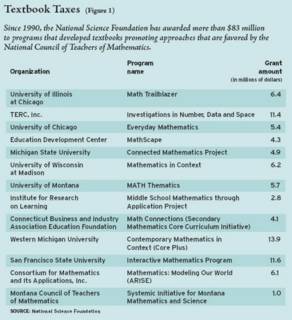
Image from Education Next
Hat tip: Joanne Jacobs
The results are described in this excellent article in Education Next by Barry Garelick.

Image from Education Next
Hat tip: Joanne Jacobs
Friday, February 04, 2005
Teachers not allowed to teach
The Bloomberg & Klein regime in NYC is in the grip of the anti-intellectual and anti-knowledge progressive/constructivist ed cult. The regime has now ordered teachers not to teach. The teachers who want to teach must now engage in guerrilla tactics and conspire with students to evade the cult enforcers.
Excerpt from Newsday story:
Excerpt from Newsday story:
Teachers want to talk
BY ELLEN YAN
STAFF WRITER
February 3, 2005
Stop talking in class -- that's the message many teachers are getting from the Education Department.
Many are ready to overthrow a "workshop model" of teaching that limits lessons to 10 minutes, with the chunk of the 40-minute period reserved for student group work -- with minimal adult interference allowed, some said -- and the last five minutes spent sharing results.
"We are no longer teachers. We are coat racks," said Steve Nathan, a social studies teacher at Russell Sage Junior High School in Forest Hills.
Chancellor Joel Klein last year introduced the workshop model primarily in math and English, but this year, critics said, many more schools across the city have been ordered to follow the model in every subject and every day.
The point is to replace the "chalk and talk" approach with a give-and-take style of learning that can help boost lagging students. It's a no-no to have students quietly jot notes all day.
One rationale is students learn well from peers, but teachers report that students without a clue aren't picking up much from each other during group work.
The result is that instructors, trying to "sneak in teaching," have been written up for workshop model lapses, union officials said. Other teachers have conspired with students to act immersed in the workshop model if an administrator pops into the room.
"Can you imagine trying to teach physics in 10-minute sound bites?" said Jeff Zahler, teachers union representative for Queens school district 30.
The model and other issues have reached such a boiling point in parts of Queens and Brooklyn that hundreds of teachers will protest at 3:30 p.m. today at education offices in Long Island City.
"This administration ... believes teachers are supposed to be coaches, not teachers," said teachers union head Randi Weingarten.
Subscribe to:
Posts (Atom)

