A mathematician once said that math was "a seamless whole" inside her head.
I don't know if this ties in with the idea of a seamless whole, but it has occurred to me that discrete skills are needed first before one can appreciate the connectedness of math. Without these discrete skills, math is more like a seamless black hole.
This became apparent to me again while teaching a group of seventh and eighth graders brought up on EM and currently using CMP who are a tabula rasa when it comes to the simplest bits of math knowledge. They can't do any operations with fractions (e.g. change mixed numbers to improper fractions let alone addition and division), can't divide decimals, don't have knowledge of even rudimentary geometry... One wonders what they have been doing for seven and eight years.
The seventh graders are currently in the CMP stretching and shrinking stage. Their homework consisted of finding the scale factor of two rectangles the width of which goes from 1.5 cm to 3 cm. So the idea was to divide 3 by 1.5 (they can't do it because they can't divide decimals). When I tried to show an alternative way of division using fractions to demonstrate the connectedness of math (seamless whole), I ran into trouble, too. They don't have the discrete skills of seeing 1.5 as 1 1/2, then changing this mixed number to 3/2 and dividing 3 by 3/2 (they absolutely can't divide fractions and moreover don't see 3 as 3/1. It would have been spectacular to make them experience with understanding that the more complicated decimal division problem 3/1.5 virtually solves itself when you divide the respective fractions (3 divided by 3/2). Invert and multiply but they have never heard of reciprocals and how they work. The 3 cancels and 2 is left standing without much ado!
So the upshot is: they use Connected Mathematics but can't see the connectedness of math because they don't have discrete skills (skills they could have learned through drill and kill but haven't). So to them, math is a seamless black hole from which not even light can escape.
Showing posts with label Fuzzy math. Show all posts
Showing posts with label Fuzzy math. Show all posts
Thursday, February 21, 2008


Thursday, January 24, 2008
TERC -- Parents rebel
Another parent group is formed to fight the fuzzy math plague. The fuzzy math program the parents are fighting is TERC (also known as Investigations).
What would it take to send those responsible for introducing these dubious programs packing?
The group's name is Teach Math Right
What would it take to send those responsible for introducing these dubious programs packing?
The group's name is Teach Math Right
Saturday, May 12, 2007
Math myths demystified
This excellent math myth debunking effort has been out now for two years and is still fresh. A sign that myths don't age easily. Educationists claim that knowledge (which educationists call "information") need not be acquired because it changes so rapidly that it virtually becomes obsolete overnight. Not true as I demonstrated here. Now if only myths would become obsolete as quickly as knowledge supposedly does. Reading myths are also nearly indestructible like viruses.
Saturday, April 21, 2007
DOE to parents: Don't mess with the fuzzies
Occasionally slightly testy but mostly to the point text savvy takes issue with the Department of Education's recommendation that parents become a cog in fuzzy math schemes:
text savvy observes dryly that parents have a long history of passing on various skills to their offspring:
Try to be aware of how your child is being taught math, and don't teach strategies and shortcuts that conflict with the approach the teacher is using. Check in with the teacher and ask what you can do to help. Ask the teacher about online resources that you can use with your child at home.(Via KTM II)
text savvy observes dryly that parents have a long history of passing on various skills to their offspring:
In case anyone (like the DOE) needs the obvious stated, parents have been successfully passing on low-order and high-order cognitive skills to their offspring long before there were schools, lesson plans, professional development seminars, research grants, or instructional philosophies.text savvy even alludes to evolutionary roots explaining this parent behavior but is willing to make exceptions for certain tribes in a bow to the phenomenon of bongo-bongoism.
New math language
In a post called Math for poets, Linda Moran cites the comments from a mother and scientist that illustrate how traditional math terms are being swept away by fuzzy math. Apparently, terms like angles and degrees are too taxing:
In TERC it isFuzzy math was designed to make math "accessible" to large segments of the population which in the view of the fuzzy math creators were hitherto marginalized by rigorous math instruction. But by taking math out of "math", everybody loses.
*joining not addition
*separating not subtraction
*bits and pieces and not fractions
*capacity and not volume
*it is what the calculator displays and not decimals.
*it is "landmarks" rather than ALL the numbers in the decimal system.
*it is turns and not angles and degrees.
*it is write a story and not write the equation.
*it is draw pictures and not show a true effective reusable strategy.
Friday, March 02, 2007
More parents fighting fuzzy math
Another parent group has formed to fight the fuzzy math plague. This time in Plainfield, NY.
Among the complaints:
Kids don't have basic skills.
Homework is unrecognizable.
Oodles spent on tutors.
Hat tip to Linda Moran.
Among the complaints:
Kids don't have basic skills.
Homework is unrecognizable.
Oodles spent on tutors.
Hat tip to Linda Moran.
Sunday, February 25, 2007
Buzzword education
(Cross-posted at KTM II)
Wikipedia has an interesting entry on buzzwords. Buzzwords may sound impressive but have an unclear meaning. Wikipedia says: "Buzzwords are typically intended to impress one's audience with the pretense of knowledge. For this reason, they are often universal. They typically make sentences difficult to dispute, on account of their cloudy meaning."
Buzzwords should not be confused with jargon. For the most part, jargon has a well-defined technical meaning, at least to the initiated. On the other hand, buzzwords not only obscure meaning, but "can also function to control thought by being intentionally vague." As Wikipedia puts it: "In management, stating organizational goals by using words with unclear meanings prevents anybody from questioning the directions and intentions of these decisions..."
What is true for management is true for education to a high degree. Education presents a veritable cornucopia of buzzwords with vague meanings. They form the feeble corpus of the educationist Thoughtworld that would be a corpse in a more rational world. (Thoughtworld is a term coined by E. D. Hirsch to describe the nebulous educationist thought complex).
Ed schools are a rich generator of educationist fog, blasting prodigious quantities of fog into the air the way Mount Pinatubo might spew massive amounts of ash into the air until the sun is reduced to a faint glow.
And yet, astonishingly and improbably, we are asked to believe that the massive amounts of fog mixed with toxic fumes emitted by ed schools magically stop at the schoolhouse door.
It's been claimed by some, including Washington Post education writer Jay Mathews (see The Ed School Disease, Part Two) commenting on educational historian David F. Labaree's new book, "The Trouble With Ed Schools," that ed schools may be pitiful institutions and the butt of jokes, but there is no need to worry. They are not doing any harm: "Why worry about ed schools if they don't do any harm, or any good?" Mathews avers:
When attempting to write about the harm done by ed school ideology, it is hard to know where to begin. One could start with relatively minor topics like the preachments about the unimportance of correct spelling and the alleged benefits of invented spelling. One could start with the promotion of disastrous creeds like constructivism that are reflected in curricula and teaching methods, and form the core of ed school ideology.
A perusal of mission and vision statements of schools show how deeply entrenched ed school ideology is in the thinking of educationists who run the schools. Take, for example, Chicago's so-called Renaissance schools. Classrooms need to be heterogeneous, disciplines must be integrated, collaborative groups must engage in peer teaching, math and science must be learned by inquiry and discovery without coherent textbooks and so on. Among my many favorites is the Al Raby school:
It is also wrong for Mathews to presume teacher autonomy. Teachers are not free agents. They must work under the contraints imposed from above. In many schools, this means having to work with fuzzy math textbooks like TERC, Trailblazers, Connected Math, CorePlus, all execrable fuzzy math programs. The CMP teacher manual tells teachers not to provide explicit instruction. Math teachers I've talked to either follow this dictum or are agonizing over it. Often it can mean working with no textbooks at all. Periodically, an ed school-indoctrinated leadership comes in and orders the removal of textbooks and workbooks from classrooms. These are then given away or end up in the trash.
Even if teachers manage to defy ed school indoctrination, the obstacles they face in actual practice are formidable. They face not only institutional constraints (e.g. constructivist materials and approaches mandated from above), but they are also facing a student body that has been conditioned to expect to be entertained and to be resistant to expository instruction.
One of the pernicious effects of ed school ideology is how it produces an indoctrinated cadre for top leadership positions which then has the power to impose constructivist texts and practices on schools, like Chicago's CMSI. This cadre could be anything from superintendents to board members to curriculum and instruction experts to principals and supervisory bodies.
The message from this cadre is that explicit instruction should be minimized or avoided altogether; that worksheets (one of the hands-on activities that make sense) should be avoided like the plague [one reason for the highly restricted photocopying allotment given to teachers here in Chicago]; that textbooks are evil incarnate and prevent teachers from being "creative". On top of everything, overworked and frazzled teachers are expected to reinvent the wheel every day. Since many elementary teachers are not well-educated to begin with (e.g. a pathetic knowledge of history, geography and science), the one source of knowledge (textbooks) that could be a corrective is foreclosed. So you have instances of textbook-free schools. Schools without basals (hated by educationists), history and science textbooks, except for science "inquiry" manuals.
Part of this hatred for textbooks is the belief -- a component of ed school ideology -- that "information" (this is how educationists view knowledge) is exploding like supernovae, and what is true today is hopelessly obsolete tomorrow. Another reason is plain educationist disdain for facts. It interferes with "critical thinking" and "creativity" and stunts the mind.
One can see the hand of ed school ideology everywhere in school. At least I see it everywhere. I see it when DEAR (Drop Everything and Read insipid, vacuous and vapid fiction) is the first thing on the agenda in the morning when students are most receptive for more substantial stuff. This reading then takes place silently for an hour without teacher feedback. I see it in block scheduling to provide ample opportunity for time-wasting activities. I see it in contrived interdisciplinary instruction and in coloring and more coloring. I see the hand of ed school ideology indirectly when new elementary teacher candidates are released from the citadels of anti-intellectualism with scant knowledge of math, science, history, geography, grammar and languages, and subsequently validated by laughable state "content" tests.
The list goes on and on. I haven't even adressed ed school staples like learning styles, multiple intelligences, developmentally appropriate injunctions that often slide into low expectations, project and activities mania, heterogeneous grouping, expanding horizons, the travesty form of Bloom's taxonomy, and the disdain for factual knowledge. Moreover, once out of ed school, teachers continue to be assaulted with ed school ideology in the form of professional development requirements.
Wikipedia has an interesting entry on buzzwords. Buzzwords may sound impressive but have an unclear meaning. Wikipedia says: "Buzzwords are typically intended to impress one's audience with the pretense of knowledge. For this reason, they are often universal. They typically make sentences difficult to dispute, on account of their cloudy meaning."
Buzzwords should not be confused with jargon. For the most part, jargon has a well-defined technical meaning, at least to the initiated. On the other hand, buzzwords not only obscure meaning, but "can also function to control thought by being intentionally vague." As Wikipedia puts it: "In management, stating organizational goals by using words with unclear meanings prevents anybody from questioning the directions and intentions of these decisions..."
What is true for management is true for education to a high degree. Education presents a veritable cornucopia of buzzwords with vague meanings. They form the feeble corpus of the educationist Thoughtworld that would be a corpse in a more rational world. (Thoughtworld is a term coined by E. D. Hirsch to describe the nebulous educationist thought complex).
Ed schools are a rich generator of educationist fog, blasting prodigious quantities of fog into the air the way Mount Pinatubo might spew massive amounts of ash into the air until the sun is reduced to a faint glow.
And yet, astonishingly and improbably, we are asked to believe that the massive amounts of fog mixed with toxic fumes emitted by ed schools magically stop at the schoolhouse door.
It's been claimed by some, including Washington Post education writer Jay Mathews (see The Ed School Disease, Part Two) commenting on educational historian David F. Labaree's new book, "The Trouble With Ed Schools," that ed schools may be pitiful institutions and the butt of jokes, but there is no need to worry. They are not doing any harm: "Why worry about ed schools if they don't do any harm, or any good?" Mathews avers:
What I said in that column was that I had been in a lot of classrooms and had rarely seen much of this guide on the side stuff. I wasn't saying I was happy about it. We have never given the Deweyites a fair test of their theories, and I know of a few schools that have used child-centered learning to good effect. Labaree's insight is powerful and useful all the same: why worry about ed schools if they don't do any harm, or any good?The blindness revealed in this statement is astonishing. Could armies of new teachers and educational leaders who go through the rigorous ed school indoctrination process really emerge unscathed? Not very likely.
When attempting to write about the harm done by ed school ideology, it is hard to know where to begin. One could start with relatively minor topics like the preachments about the unimportance of correct spelling and the alleged benefits of invented spelling. One could start with the promotion of disastrous creeds like constructivism that are reflected in curricula and teaching methods, and form the core of ed school ideology.
A perusal of mission and vision statements of schools show how deeply entrenched ed school ideology is in the thinking of educationists who run the schools. Take, for example, Chicago's so-called Renaissance schools. Classrooms need to be heterogeneous, disciplines must be integrated, collaborative groups must engage in peer teaching, math and science must be learned by inquiry and discovery without coherent textbooks and so on. Among my many favorites is the Al Raby school:
Educational Philosphy [sic]Many of these new Chicago schools receive money from the Gates Foundation.
The Al Raby School will embody a constructivist approach to learning. Learning will be an active process; our teachers will use lecture style instruction and worksheets sparingly. All teachers will stress collaborative groups as well as individual initiative, striving to make the classroom a model democratic community where students have choices and responsibilities. Based on a large body of research, we believe that for true comprehension and retention to occur the learning must be relevant, active and reflective.
It is also wrong for Mathews to presume teacher autonomy. Teachers are not free agents. They must work under the contraints imposed from above. In many schools, this means having to work with fuzzy math textbooks like TERC, Trailblazers, Connected Math, CorePlus, all execrable fuzzy math programs. The CMP teacher manual tells teachers not to provide explicit instruction. Math teachers I've talked to either follow this dictum or are agonizing over it. Often it can mean working with no textbooks at all. Periodically, an ed school-indoctrinated leadership comes in and orders the removal of textbooks and workbooks from classrooms. These are then given away or end up in the trash.
Even if teachers manage to defy ed school indoctrination, the obstacles they face in actual practice are formidable. They face not only institutional constraints (e.g. constructivist materials and approaches mandated from above), but they are also facing a student body that has been conditioned to expect to be entertained and to be resistant to expository instruction.
One of the pernicious effects of ed school ideology is how it produces an indoctrinated cadre for top leadership positions which then has the power to impose constructivist texts and practices on schools, like Chicago's CMSI. This cadre could be anything from superintendents to board members to curriculum and instruction experts to principals and supervisory bodies.
The message from this cadre is that explicit instruction should be minimized or avoided altogether; that worksheets (one of the hands-on activities that make sense) should be avoided like the plague [one reason for the highly restricted photocopying allotment given to teachers here in Chicago]; that textbooks are evil incarnate and prevent teachers from being "creative". On top of everything, overworked and frazzled teachers are expected to reinvent the wheel every day. Since many elementary teachers are not well-educated to begin with (e.g. a pathetic knowledge of history, geography and science), the one source of knowledge (textbooks) that could be a corrective is foreclosed. So you have instances of textbook-free schools. Schools without basals (hated by educationists), history and science textbooks, except for science "inquiry" manuals.
Part of this hatred for textbooks is the belief -- a component of ed school ideology -- that "information" (this is how educationists view knowledge) is exploding like supernovae, and what is true today is hopelessly obsolete tomorrow. Another reason is plain educationist disdain for facts. It interferes with "critical thinking" and "creativity" and stunts the mind.
One can see the hand of ed school ideology everywhere in school. At least I see it everywhere. I see it when DEAR (Drop Everything and Read insipid, vacuous and vapid fiction) is the first thing on the agenda in the morning when students are most receptive for more substantial stuff. This reading then takes place silently for an hour without teacher feedback. I see it in block scheduling to provide ample opportunity for time-wasting activities. I see it in contrived interdisciplinary instruction and in coloring and more coloring. I see the hand of ed school ideology indirectly when new elementary teacher candidates are released from the citadels of anti-intellectualism with scant knowledge of math, science, history, geography, grammar and languages, and subsequently validated by laughable state "content" tests.
The list goes on and on. I haven't even adressed ed school staples like learning styles, multiple intelligences, developmentally appropriate injunctions that often slide into low expectations, project and activities mania, heterogeneous grouping, expanding horizons, the travesty form of Bloom's taxonomy, and the disdain for factual knowledge. Moreover, once out of ed school, teachers continue to be assaulted with ed school ideology in the form of professional development requirements.
Saturday, February 17, 2007
Math research hoax

Fuzzy math enthusiasts and curanderos like to point to alleged "research shows" to help peddle their wares.
Let the colonel explain.
Excerpts from a stunning report from the National Research Council posted on KTM II show that there is no there there.
Among other things, the committee finds that:
The corpus of evaluation studies as a whole across the 19 programs studied does not permit one to determine the effectiveness of individual programs with high degree of certainty, due to the restricted number of studies for any particular curriculum, limitations in the array of methods used, and the uneven quality of the studies.As a bonus, there is a list of rogue fuzzy math programs, most of them financed with tax dollars through the EHR directorate of the National Science Foundation:
Elementary School:
• Everyday Mathematics (EM), Grades K-6 (SRA/McGraw-Hill)
• Investigations in Number, Data and Space, Grades K-6 (Scott Foresman) [ed.: also called "TERC"]
• Math Trailblazers, Grades K-6 (Kendall/Hunt Publishing Company)
Middle School:
• Connected Mathematics Project (CMP), Grades 6-8 (Prentice Hall)
• Mathematics in Context (MiC), Grades 5-8 (Holt, Rinehart and Winston)
• MathScape: Seeing and Thinking Mathematically, Grades 6-8 (Glencoe/McGraw-Hill)
• MathThematics (STEM), Grades 6-8 (McDougal Littell)
• Middle School Mathematics Through Applications Project (MMAP) Pathways to Algebra and Geometry, Grades 6-8 (currently unpublished)
High School:
• Contemporary Mathematics in Context (Core-Plus), Grades 9-12 (Glencoe/McGraw-Hill)
• Interactive Mathematics Program (IMP), Grades 9-12 (Key Curriculum Press)
• MATH Connections: A Secondary Mathematics Core Curriculum, Grades 9-12 (IT’S ABOUT TIME, Inc.)
• Mathematics: Modeling Our World (MMOW/ARISE), Grades 9-12 (W.H. Freeman and Company)
• Systemic Initiative for Montana Mathematics and Science (SIMMS) Integrated Mathematics, Grades 9-12 (Kendall/Hunt Publishing Company)
This list can help parents spot the offending and immensely damaging voodoo math programs in their schools so they can raise hell.
Tuesday, February 13, 2007
Fuzzy math cartoon

UPDATE: In the latest, Steve advises Bill on where to find designers for Bill's latest project. Get them from the discovery schools Bill supports. Good advice for a competitor. If Bill takes the advice, I recommend shorting MSFT.
Check out this fantastic cartoon series at Weapons of Math Destruction. It's all about the ravages of fuzzy math.
I like the one where Einstein goes on a discovery journey and discovers the Pythagorean Theorem. Yeah, keep reinventing the wheel. That should be the motto of the fuzzies.
Saturday, January 20, 2007
Fuzzy math video
Parents who are bewildered by the kind of math their children are exposed to in school should watch this video. A parent who is also an atmospheric scientist demonstrates how multiplication and division problems are done with this new-fangled math. Incredibly confusing stuff for a kid, done to avoid standard algorithms.
This link of the video called Math Education: An Inconvenient Truth takes you to the YouTube site. The video has sparked a lively discussion at YouTube that includes a few defenders of fuzzy math. This is an example:
This link of the video called Math Education: An Inconvenient Truth takes you to the YouTube site. The video has sparked a lively discussion at YouTube that includes a few defenders of fuzzy math. This is an example:
Kids will "learn math" if they are given an opportunity to discover. Kids want to explore things. If you tell them that this is the way to do it, you have (for many, but not all) squelched their creative energy. They are reduced to just finding the answer. Kids want to understand the language of math. In the standard division algorithm, we use the term "goes in to". What does that mean to a kid just beginning to learn the concept of division? What is a "remainder"?This is what I don't understand. If kids are so eager to discover, why are they not discovering on their own outside school? If this were true, nearly every child would be math proficient.
Saturday, January 06, 2007
Perversity in Chicago
Like so many big cities, Chicago has a huge number of underperforming schools who get placed on a probation list, thanks to NCLB. What is the school board's answer to ailing schools? Administer a massive dose of poison!
In what can only seem to be head-shaking perversity, the board forces something called the Chicago Math and Science Initiative on ailing schools, enforced by its network of so-called Area Instructional Offices.
As can be seen from the instructional materials used by CMSI, it's all of the worst fuzzy type:
The science component is of a similar vein. All "inquiry" and discovery and no foundational knowledge.
In what can only seem to be head-shaking perversity, the board forces something called the Chicago Math and Science Initiative on ailing schools, enforced by its network of so-called Area Instructional Offices.
As can be seen from the instructional materials used by CMSI, it's all of the worst fuzzy type:
Purpose: To promote instructional coherence across K-8 mathematics classrooms by recommending and supporting specific research- and inquiry-based instructional materials.Students who desperately need structure, coherence, instruction and solid foundational knowledge are fed this fuzzy crap, guaranteed to perpetuate failure.
Description: The mathematics instructional materials designated for grades K-8 in the Chicago Public Schools are:
Primary Grades Mathematics: Math Trailblazers and Everyday Mathematics
Middle Grades Mathematics: Connected Mathematics and Math Thematics
This information can be used as a resource by other elementary schools that seek to align their use of instructional materials with that supported by CMSI.
The science component is of a similar vein. All "inquiry" and discovery and no foundational knowledge.
Sunday, November 13, 2005
Alternative to fuzzy math denied
An illuminating story appeared in the NYT on how the fuzzy math plague plays out in a Rochester, NY, suburb:
After citing example after example of math cripples, the article has this gem that shows the arrogance of educationists:LAST spring, when he was only a sophomore, Jim Munch received a plaque honoring him as top scorer on the high school math team here. He went on to earn the highest mark possible, a 5, on an Advanced Placement exam in calculus. His ambition is to become a theoretical mathematician.
So Jim might have seemed the veritable symbol for the new math curriculum installed over the last seven years in this ambitious, educated suburb of Rochester. Since seventh grade, he had been taking the "constructivist" or "inquiry" program, so named because it emphasizes pupils' constructing their own knowledge through a process of reasoning.
Jim, however, placed the credit elsewhere. His parents, an engineer and an educator, covertly tutored him in traditional math. Several teachers, in the privacy of their own classrooms, contravened the official curriculum to teach the problem-solving formulas that constructivist math denigrates as mindless memorization.
"My whole experience in math the last few years has been a struggle against the program," Jim said recently. "Whatever I've achieved, I've achieved in spite of it. Kids do not do better learning math themselves. There's a reason we go to school, which is that there's someone smarter than us with something to teach us."
By last spring, these parents had discovered one another and their common exasperation with constructivist math. Jim Munch's father, Bill, a software developer at Kodak, drew up a petition asking the Penfield schools to offer pupils the option of taking traditional math. Nearly 700 residents signed it. Last June, the Board of Education turned down the request.The superintendent haughtily dismisses parent concerns. Many of the parents have extensive math backgrounds:
Susan Gray, the superintendent, attributed the criticism of the math program to "helicopter parents" who are accustomed to being deeply involved in all aspects of their children's lives. "Because the pedagogy has changed, the parents who knew the old ways didn't know how to help their children," she said. "They didn't have the knowledge and skills to support their children at home. There's a security in memorization of math facts, and that security is gone now."
YET many of the dissident parents have extensive math backgrounds and thus the ability to criticize the curriculum. It is also true that most of them tolerated the constructivist program for its first several years, until bitter experience drove them into rebellion.
Friday, April 01, 2005
Fuzzy math keeps spreading
This writer is making a nice analogy between reading and math. Just because technology is available, should we stop teaching kids how to read? Fuzzy math promoters seem to believe something similar by encouraging the use of calculators at an early age and by displaying hostility to memorization. The result is another generation of math cripples. Memory is one of those great gifts. It is therefore incomprehensible why educationists would wage war against memory.
To put this into perspective, consider the following analogy: Your first-grader comes home from school and tells you about the new Everyday Reading curriculum. Since there's such a prevalence of "books on tape," and with the latest technology known as text-to-speech, allowing computers to speak any text, the schools have implemented this great new program. It removes the emphasis on memorizing the alphabet and the tedium of learning to read. No more wasting time on the trivial, tedious basic mechanics of reading. No more hours spent on phonics or spelling. The new curriculum spends much more time teaching the children to analyze complex literature from a young age, since they're now freed up from the tedium of actually READING it!
Thursday, February 24, 2005
Pundit parents
The Education Wonks have done it again and assembled a delicate smörgåsbord from the edusphere.
What caught my attention, in particular, was a pundit parent's experience with EM: If your school has Everyday Math. Fortunately, there are parents who care enough about education to make an end-run around fuzzy math by either buying the right books, teaching their kids, hiring a tutor or tutoring program or all of the above.
The post also contains a long, long (and I mean looong) response from a true believer in fuzzy math, replete with accusations of "bald-faced lies" and the like.
I have often wondered to what extent the effects of fuzzy math are distorted by interference from parents. Imagine a district using fuzzy math and a number of students doing splendidly on tests (assuming the tests are not fuzzy tests). Then the results are trumpeted by the district and seen as vindication. But it turns out the results are due to what pundit parents and many others like her did: getting their kids the benefit of real math.
Sunday, February 20, 2005
More on massive government funding of fuzzy math
Not even the President of the country can defeat the zealous forces of fuzzy math.
This editorial appeared almost a year ago in The Education Gadfly and was written by David Klein, a professor of mathematics at California State University. Apparently, nothing has changed.
http://www.edexcellence.net/foundation/gadfly/issue.cfm?id=138#1708
Excerpt:
This editorial appeared almost a year ago in The Education Gadfly and was written by David Klein, a professor of mathematics at California State University. Apparently, nothing has changed.
http://www.edexcellence.net/foundation/gadfly/issue.cfm?id=138#1708
Excerpt:
Will Congress hurt or help K-12 math education?
Much like the "reading wars" between phonics instruction and whole language learning, the K-12 "math wars" have raged for more than a decade. With many defeats and only occasional victories, parents, education reformers, and a number of university mathematicians have struggled against "fuzzy math" in schools. Now President Bush is proposing a bold plan to improve mathematics education, but some members of the House—even some members of his own party—are resisting.
The Problem
"Fuzzy math," a philosophical sibling of whole language learning, refers to textbooks and school programs that intentionally de-emphasize basic arithmetic and algebra skills. At the elementary school level, these programs encourage students to invent their own arithmetic procedures, while discouraging the use of the traditional and far superior methods for addition, subtraction, multiplication, and division. Calculator use is encouraged to excess—in some cases, they're even included in kindergarten lesson plans, at precisely the age that students should be learning basic computational skills unaided. Student "discovery group work" is the preferred mode of learning, sometimes the only mode, and the discovery projects are almost invariably incoherent and aimless. Some of the elementary school fuzzy math programs do not even provide textbooks for students, as books might interfere with student discovery projects. Arithmetic and algebra are radically de-emphasized by these programs. In the higher grades, mathematical definitions and proofs are generally deficient, missing entirely, or even incorrect.
The principal funding source of fuzzy math for the past decade has been the federal government by way of the Education and Human Resources (EHR) division of the National Science Foundation (NSF). The EHR is the directorate within the NSF that funds K-12 education projects. No single institution in the United States has caused more damage to the mathematical education of children than this low-profile bureaucratic unit of the National Science Foundation. The damage that the EHR has caused, and continues to cause, contrasts sharply with the NSF's overall admirable and important role in supporting fundamental scientific research.
For example, in October 1999, the U.S. Department of Education released a list of 10 so-called "exemplary" and "promising" math programs that it recommended for the nation's 15,000 school districts. More than half of these "exemplary" and "promising" math programs were created with EHR funding, and the rest were and are aggressively promoted by the EHR. On the list were some of the worst math education programs in the country. For example, one of the "promising" curriculum called Everyday Mathematics calls calculators are "an integral part of Kindergarten Everyday Mathematics" and urges the use of technological aids to teach kindergarten students how to count. There are no textbooks in this K-6 curriculum—a serious shortcoming. The program assigns the standard algorithm for multiplying two numbers no more status or prominence than an Ancient Egyptian algorithm presented in one of the teacher's manuals. Students are never required to use the standard long division algorithm in this curriculum, or even the standard algorithm for multiplication.
Saturday, February 19, 2005
Taxes finance fuzzy math
The role played by the tax-supported National Science Foundation (through its EHR division) in promoting fuzzy math is a scandal of monumental proportions. This NSF division was captured by fuzzy (constructivist) math fanatics some time ago and has been conducting an aggressive tax-financed campaign ever since to spread the constructivist gospel far and wide.
The results are described in this excellent article in Education Next by Barry Garelick.
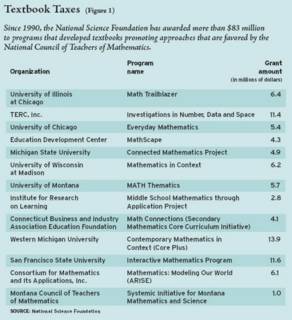
Image from Education Next
Hat tip: Joanne Jacobs
The results are described in this excellent article in Education Next by Barry Garelick.

Image from Education Next
Hat tip: Joanne Jacobs
Subscribe to:
Posts (Atom)


